Sunday, March 6, 2011

AVDAT - עבדת - OBODAT - NABATEAN CITY IN THE NEGEV DESERT

Imagine, once upon a time, almost 2500 years ago, a tribe from Arabia began wandering the desert. The nomads knew they could not rely on natural occurrence of water. Being very clever people, known today as Nabateans, they started their future commercial success with building series of well hidden, plastered, covered and protected cisterns, never depending on sources of water of rare springs and occasional rain, herewith establishing a thriving culture in the sandy and stony plains and hills of the desert which lasted 700 years. They started to trade spices. 
The camel was domesticated already long before, and so they organized big caravans on a route that stretched from Oman and Yemen to Jordan, and from there via the Negev desert to the port in Gaza on the Mediterranean shore. They brought pepper, cardamon, cinnamon, saffron and ginger, spices that came from India in big ships via the ocean to Arabia. And they bought frankincense and myrrh in Yemen, two resins, which release their characteristic scent when burned. Both incenses were very essential in the religious rites of the ancient people. You remember the three Wise Men from the East, who brought to the newborn Jesus a present of frankincense and myrrh? Till today frankincense is widely used in Christianity. In Gaza they sold those precious products of the Orient for enormous sums and made huge profit. Then those goods got transported to Europe, to Greece and Rom. The Incense Road was born, and it flourished from the third century BCE to the fourth century CE.
The mountainous Negev desert is a harsh territory, the journey through it was very difficult, threatened often by sandstorms. Rest stops were needed and created, which, first being very modest, developed over time into fortresses and then into Nabatean cities, with Petra in Jordan being their legendary necropolis. http://pazzapazza2.blogspot.com/2010/03/petra-jordan.html  As their wealth constantly increased the Nabateans eventually settled down, and through contact with many different people they adapted elements of their cultures. Greek and Roman influences were evident in religion, language and architecture. The Incense Route had many stations. I wrote about one of the six major ones in the Negev, Shivta, in a previous post. http://pazzapazza2.blogspot.com/2010/10/shivta.html Another very important one was Avdat, or Obodat, named after a Nabatean king, who is buried there. The city was inhabited by Nabateans, Romans and Byzantines.
So last Thursday my husband took leave from work and we went with my niece for a day long adventure to the desert to visit Avdat, which is located off Route 40 between Kibbutz Sde Boker and Mitzpe Ramon, about 15 minutes drive from Sde Boker in the Negev highlands, where the old routes from Petra and Eilat meet and continue to the Mediterranean coast. The ancient caravan station evolved into a large desert city. It lays on a hilltop, about 80 meters high, and is completely surrounded by a wall.
On the plain around Avdat traces of ancient agriculture are visible, with foundation walls indicating farms, and detectable lines on the grounds, suggesting boundaries of fields and gardens. The Nabateans developed sophisticated techniques to irrigate the desert and channel the water from floods. Many modern farmers and winegrowers terrace their land after Nabatean patterns. Just now almond trees are blooming there.
On the way up to the city we saw many caves, carved out of the sandstone in the flanks of the hill, which were used for storage.

The ruins we see today are the foundations of the caravansary, the city fortress, the living quarters of a roman army camp, two churches from Byzantine times, with a basin in form of a cross for baptism, built over a Nabatean temple, a pottery workshop, a Byzantine house, a very well preserved structure of a Roman villa, a bath house, as well as several wine presses from Byzantine time and of course walls and walls and walls, many fallen down, of housing. 
We found two marble slabs, covering graves, on the floor with Greek inscriptions, and one has a Jewish Menorah on it, we could not find out what the text says.
Great treasure is still buried under the ground and while we visited there a crew was working to uncover more. 
The city was destroyed by earthquake in the 7th century and stayed deserted, but evidence of ancient life and economics is everywhere to be seen. Cisterns are present and fenced in, many vaults and arches have been preserved over the centuries, and walls and columns were reconstructed to give a better understanding of the place.


Strolling through the ruins is easy and very fascinating. The hours we spent there were filled with excitement, wonder and discussions about the life of the different people during all the centuries.
What did they wear? How was their food?  Was their wine good? Where did they cook and bake and what? How did their earthenware look? Did they grow sheep? What was the place of women in their society? Who worked the gardens and fields? What did the children play? What about education? Leisure? 
It was fun to imagine, to assume and to dream. The weather was pleasing, sunny, with a little wind blowing in our faces. The view of the desert all around is beautiful. We had a great day of history, nature and companionship!
The photographs were taken by all three of us.

Friday, March 4, 2011

BNEI ZION - NATURE RESERVE

Three o.clock at dawn - off she went, her plane is about to leave in an hour. Photos from yesterday morning of a last walk not far from where we live. This week went so fast, but we enjoyed every moment! Good by Judith, thank you for being here, come again soon girl!

Orchids, tulips, iris - how splendid!

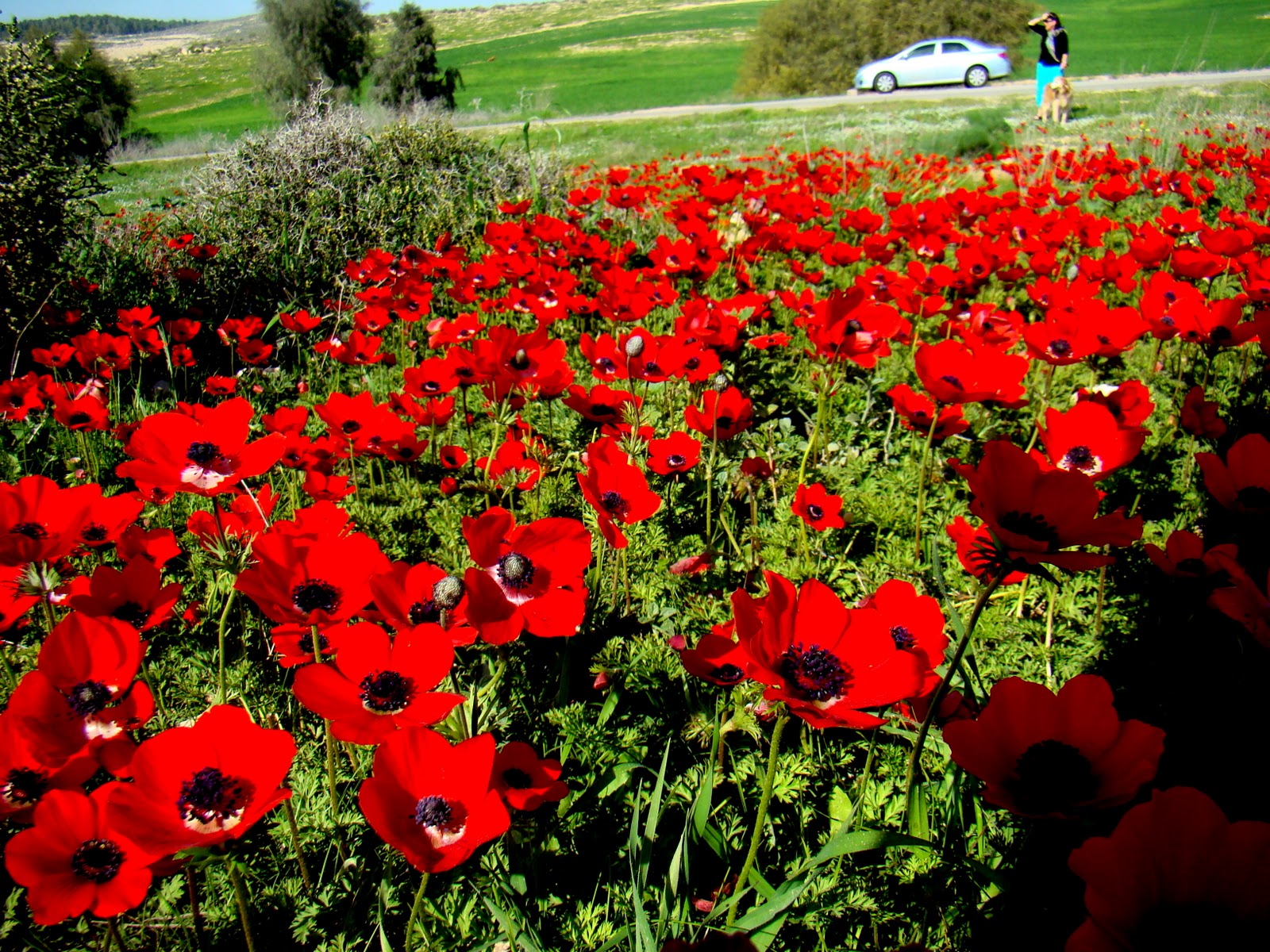
KALANIOT - כלניות - WILD ANEMONES


There are so many wildflowers blooming in Israel right now and the weather is nice, warm and sunny, but not hot - yes, sometimes I think I live in paradise!

Photos by my husband Uri - but REALLY - with nature providing SUCH material... :-)
Photo with the sheep by my niece.

Wednesday, March 2, 2011

THE BEACH

is another MUST!


Tuesday, March 1, 2011

SHUK HA PISHPESHIM IN YAFO


My niece is here from Germany for a short vacation - and of course a visit to the fleamarket in Yafo is a MUST! Enjoy some impressions!


Oh yes, I know you all would have liked to be with us! Next time!

This time I was the photographer.