Sunday, November 7, 2010

EXHIBITION OF MOSAIC ART AT THE MORMON CENTER IN JERUSALEM

While visiting the Mormon Center in Jerusalem (see last post) a wonderful Israeli/Palestinian exhibition of artful works of mosaics was on display in one of the beautiful arched halls.
"The art of mosaic described in Wikipedia as the art of creating images with an assemblage of small pieces of colored glass, stone or other materials.
Tesserae (borrowed from the Greek word "pebble") of small pieces, normally roughly cubic, of stone or glass of various colors, are used to create a pattern or picture.
Mosaic is very much in vogue today, despite the tendency to consider it rather a craft than an art form. Perhaps it is difficult to accept the fact that mosaics often have a dual function, i.e. as artistic design as well as floor and wall covering, and also because it is a very accessible and non elitist form of creativity. However, the field is rich with new ideas and approaches, insuring mosaic an honored place among other art forms, as this exhibition bears out.
The idea for the exhibition grew from the desire to use our beautiful hall to exhibit diverse forms of art....
....The fourteen participating artists were given a theme: to create their own mosaic based on an ancient one found in our region, thus giving it their own personal reading. As can be seen from the results, the artists' imagination flared, and the diverse interpretations display a wealth of human expressions. Some adhered closely to the origin, while others went further afield from the prototype. Some of the works were made using the ancient classical method, and also the reversed method was used, gluing the stones on a temporary base and after pouring a backing, turning the mosaic over.......
....The exhibit itself is a mosaic of genders, ages, nationalities, religions and ideas suited to this art form and to the building that hosts it."
Those are excerpts from the flier of explanation, laid out to read at the exhibition. 


I did not match the names of the artists to the photos, simply because I did not write them down. Just get an impression of some of the fantastic pieces on display. They are all beautiful and exceptional. If you live near by do yourself a favor and go to visit!

Saturday, November 6, 2010

THE MORMON CENTER IN JERUSALEM

Built by Israeli architect David Reznick and  American architect Frank Ferguson on a slope at Mount Scopus in Jerusalem, adjacent to the Hebrew University, and completed in 1988, the Mormon Brigham Youth University of the Church of Jesus Christ of Latter-day Saints, blends wonderfully into the surrounding landscape. Its erection has been a very controversial issue for years. To get the permission to construct the building, the church had to promise to stay away from any missionary activities, not to try to proselytize Israel's Jewish residents and not accept Jewish students. About 170 students are enrolled there at any given time for one semester abroad. The program focuses on the Old and New Testament, ancient and modern Near Eastern studies and  includes the Hebrew and Arabic languages.
I am not going into the political and religious debates,  but only wish to talk about the wonderful gorgeous and exquisite edifice with its arches and domes and its extraordinary style! Visiting there yesterday morning we have been stunned by the beauty and elegance of it! 
The location chosen is perfect, with a panorama overlooking the Mount of Olives, the Kidron Valley, the Old City of Jerusalem with the ancient city wall and the temple area and the Arab quarters to the right.
Welcomed warmly we were given a tour of the place. The tour guide will not offer any religious explanations and neither answer religious questions of any kind.
The building is composed of eight levels, not stacked one on each other but terraced on the slant of the hill, with space for housing students and staff, classrooms, computer facilities, a library, lecture rooms, offices, a cafeteria, and a gym, as well as a big auditorium on the seventh level. On the eighth level, which is the entrance level is suited another auditorium with the spectacular organ. We were invited to sit down in front of the arched windows looking out right at the Dome of the Rock and the El Aksa Mosque to the left and given a recital of three very different musical pieces to fully appreciate the sound of this magnificent instrument, comprised of 3000 pipes!
This auditorium serves as a concert hall too and is designed with the purpose to let natural light in through the arched windows from all directions, filtered with the use of wooden checkered panels. On Sunday nights concerts of classical music and Jazz are given free of charge and the public is invited.
After passing an impressive beautiful 700 years old olive tree the entrance is through an iron gate which resembles a menorah when closed.
The main building materials of the whole center are Jerusalem stone, Italian marble, glass and wood, especially oak and imported teak. The interior decoration is very pleasing with local antique mosaic fragments on loan on the walls and comfortable sitting areas everywhere. 
The play of light and shadow in the alleyways, corridors, terraces and internal courtyards is soothing and gives a calm and peaceful atmosphere. The various styles melt together and produce a very pleasing design. Four models of Jerusalem featuring different periods in time from its history are displayed at the large sun flooded arched terrace at the highest level.
As much attention is given to the building, the gardens are tended as well and are equally beautiful. Two fountains flank the entrance.
Latticed wooden canopies provide shade. Abundant with foliage fitting the nature of the land of Israel, the garden was planned beautifully by landscape designer Dan Tzur. While strolling on the paths we noticed olive trees, citrus trees, pomegranate trees, many plant specimens mentioned in the Bible, and smelled and enjoyed the fragrant herb gardens.
We had a wonderful time and we thank our guide Joseph for his friendly and tactful ways of showing us around and the organ player for his wonderful performance!
Photographs by Uri Eshkar.

Friday, November 5, 2010

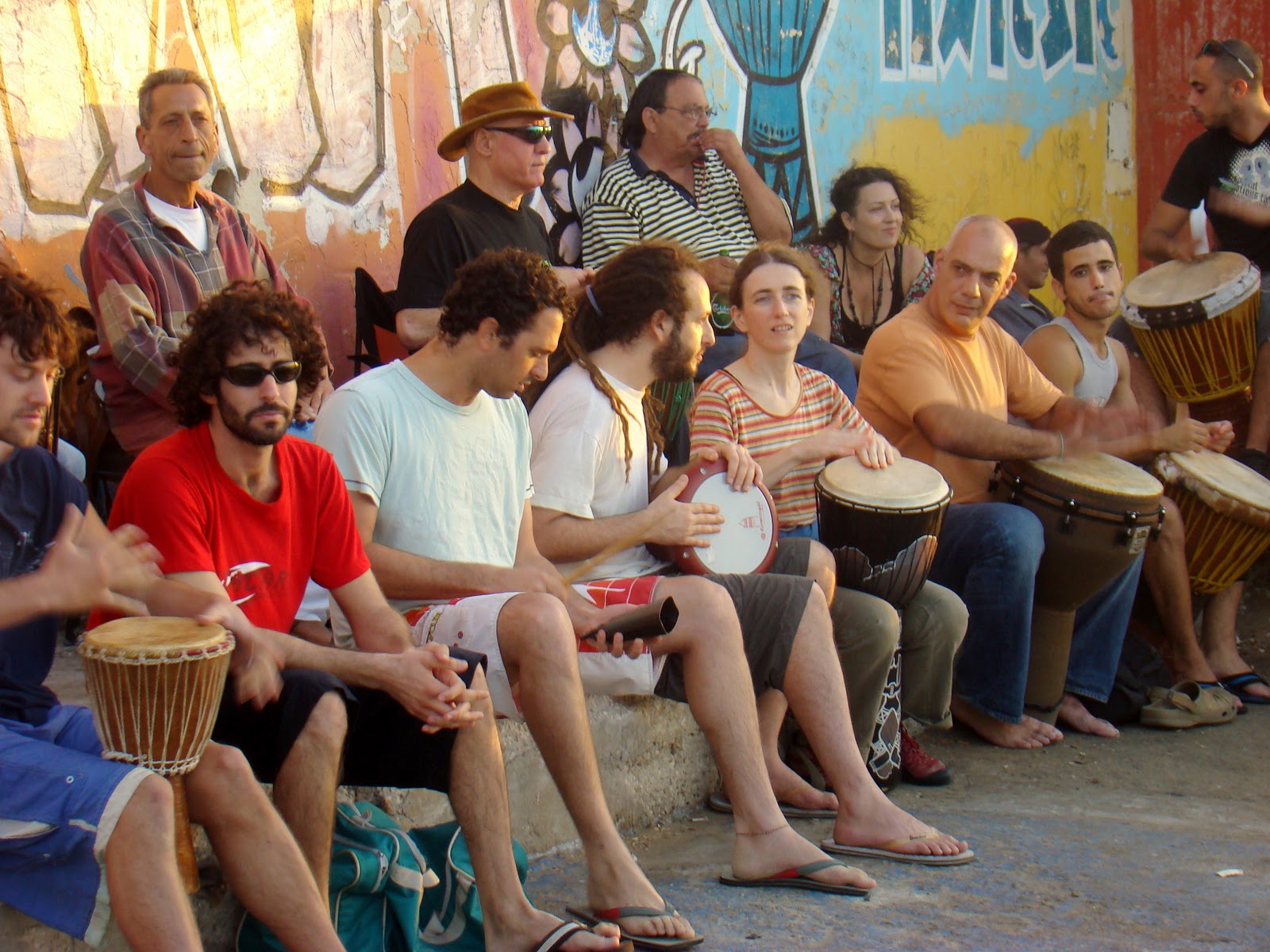
THE BEACH AND THE DRUMMERS

Today in the afternoon in Tel Aviv at the sea shore! 
The drummers meet in this corner every Friday towards the evening already for years - everyone is welcome to drum with them! 
Fantastic vibe right into the sunset - oops, but the camera battery went empty!
Photos by my husband Uri.

Thursday, November 4, 2010

WHO ARE YOU? WHERE DID YOU COME FROM? WHERE ARE YOU GOING?

Cotton, decorator fabric scraps, machine pieced, appliqued and quilted
61 cm x 81 cm

Sunday, October 31, 2010

MEGIDDO

After hibernating all summer and refraining from going on trips under the scorching sun, the time has arrived to "get up and go out" again! So yesterday we left Golda in the care of our son and went to visit Megiddo, together with half of my daughter's family, which means her and the two younger children, Noam and Yasmin.
Megiddo is located on a hill of about 60 meters height, at the Carmel ridge, in northern Israel, near Haifa, in the vicinity of a Kibbutz with the same name. And the name Armageddon mentioned in the New Testament derives from Har Megiddo, which is Hebrew and means Mount of Megiddo.  This place is OLD, VERY old. Without knowing anything about the history of Megiddo and Shivta, one can see clearly by comparing the photos of both sites, that Megiddo is much much more ancient!
By the year 3000 BCE Megiddo was already a city of great importance. Because of its strategic location it guarded an ancient road which connected Egypt with the land of Mesopotamia in the North. Named
"Derech ha Yam" ( the way along the sea), it became later a very important and strategic trade route of the Roman Empire, called Via Maris.
But since tools and pottery shards from very early times were discovered,  human habitation of the place can be traced back as far as to the year 7000 BCE, which would be the Neolithic Period!
Megiddo was the target of many battles throughout its history, between Egyptian armies and Canaanites, between Egypt and the kingdom of Judah and in our times between the troops of General Allenby and the Turkish army in World War I.  The tell is composed of up to 26 layers of ancient ruins and cities, built one above the other over thousands of years. It is uninhabited since 586 BCE, which preserved the ruins quite well, never deranged by newer settlements. So imagine, the upper, undisturbed latest layer is about 2500 years old!!
I don't intend to dig here too much into the history of Megiddo, that would be too complex -  there is plenty of information to be found on the Internet. The photos will present an impression of the place, the ancient dwellings will give a hunch of the grandeur and an idea of the importance!
Dwellings from the Israelite period are present. There are two entrance gates, the Canaanite and the Israelite. The Canaanite palace. A northern and a southern palace. Four temples in all, from different periods. A huge granary. A very impressive water system, which can be explored, 187 stairs going down, walking through the tunnel, ascending 87 stairs up on the other side and stepping out at the foot of the tel. We saw stables which could host hundreds of horses, many of the feeding troughs intact, first thought to be from the time of Solomon, but now dated 150 years later to the time of king Ahab. A burial chamber, which was found empty and its date is undetermined. Stairs leading down to a plastered water pool. A circular altar ground from the Canaanite era, where animal bones have been found. Assyrian palaces from the period when Megiddo was the capital city of an Assyrian district.
Many of the finds at Megiddo can be clearly identified and classified, about others the archaeologists and historians argue, have opinions or simply know nothing.
To visit there is a wonderful experience and time out! The place is beautiful, the view from above is absolutely  breathtaking, a big part of Israel :-) can be seen turning around, from the Iron Valley (Wadi Ara) to the Jezreel Valley, the Carmel range, Nazareth, Mount Tavor, the Moreh hill and the Gilboa mountains! Further to the southeast one can spot Jenin and the mountains of Samaria and to the south the city of Um al-Fahm, yes half of Israel almost! 
Many palm trees have been planted long ago on the site, they fit perfectly with the ancient stones, and together with the ruins give you a feeling of being lost in time...
Resources: Wikipedia, the flier distributed at the entrance of the Megiddo National Park, and the vast knowledge of my husband.
Photographs by Uri Eshkar