Sunday, June 26, 2011

ISN'T IT LOVELY?


I did not buy handles yet for the black and red bag with the Bedouin embroidery. But I finished the other one - blue and green. It came out very nice with those little embellishments. I even don't remember where I found the pretty and colorful masks, I had them for ever. I think they are made from papier mache, and painted with acrylic. The beads are from a necklace I brought home from a market in the Provence while on vacation there some years ago. I did not like the necklace, I just wanted the beads. 

And the rings at the strap? Well those I saw just yesterday evening while strolling in a shopping mall. They had set up some fashion stands in the corridors and at one of them they sold plastic bracelets and rings. The bag was ready but for the strap and I was rolling ideas in my mind how to make it a bit more special - ha, those humble rings suited me just fine - they go perfectly with the masks, the beads and the button. 
The button is not for closure, just for prettiness, there is a magnetic snap under it!
The back side.
Size of the bag: 12" high, 12" wide at the bottom, 2,5" deep at the bottom. (ca. 30cm x 30cm x 7cm)

Thursday, June 23, 2011

BAGS BAGS BAGS - ANOTHER PEEK


I am working on two more bags from the upholstery fabric I got from my daughter. This one actually is finished, except for the handles. I have wooden handles I wanted to add, but as it turned out they are too small, so I will go to Tel Aviv next week and buy some bigger ones. I could make fabric handles or even handles from leather, I have a small piece of black leather which could be enough, but now I am stubborn, I want wooden handles on that bag! I found this marvelous piece of Bedouin embroidery at the flea market in Jaffa, it was part of a dress - look at those meticulous stitches - it goes fantastic with the velvety black and red fabric!


And here is the lining of the second one, I had leftovers of green and used the blue with this gorgeous striped batik fabric which I had for a long time. A very lovely small bag will come out of it! I made simple inside pockets with Velcro closure.


What is left now from this treasure are the beige colors with some brown. I wait till an idea hits me! :-)

DAFNA


Dafi is with us since she was six weeks old, she will be twelve by the end of the year.  She is a beautiful mixed bred between a Golden Retriever and a Labrador.
She has the most dear and wonderful personality, she absolutely obeys and she is sweet and loving and loyal. She trusts and can be trusted. She knows how to smile.
She is kind with all our cats and very protective of them. She loves to drive in the car and to go on hikes with us, she is never demanding, she is very patient, she adores food (!), she is outgoing with people - she is just SO loveable!

Tuesday, June 21, 2011

SIMPLY ELEGANT


Upholstery fabric, leather handles.
Same design on back and front.
Fully lined with beautiful light green woven fabric.
Two inside pockets in the same wavy design.
Size: 12" x 14" x 4" (ca. 31cm x 36cm x 10cm)

Sunday, June 19, 2011

BEIT SHEARIM


Kiryat Tivon is a small beautiful town in the Lower Galilee, about 20 km east of Haifa. My husbands aunt lives there and from her house it is a ten minute walk down the hill to Beit Shearim,  בית שערים, the ancient Jewish town. Most of the ruins of the town itself are covered by the forests of the hill and still not excavated. But the towns burial place which is cut straight into the rock, is dug out and laid bare, and almost each time we visit that aunt we take a walk down the hill to stroll around.
During the period of the Second Temple Beit Shearim was one of many small settlements in the Galilee. After the occupation of Jerusalem by the Roman empire in the 2nd century CE  the center of Jewish life shifted from Judea to the Lower Galilee and the exiled Jews established in the already existing town of Beit Shearim their headquarter for the Sanhedrin, the ancient Jewish court system and highest legal and ecclesiastical authority. The rock-cut cemetery became sought out after Rabbi Juda HaNasi, the compiler of the Mishna and great leader at the Sanhedrin during that time, was laid to rest there. After his death the grave yard became famous and significant. Many more graves were hewn out of the stone for more than hundred years and Beit Shearim became a very important and expensive burial site and the largest and most prominent necropolis in the Levant, not for the common people, but for rich and influential Jewish families in Israel and the countries around it.


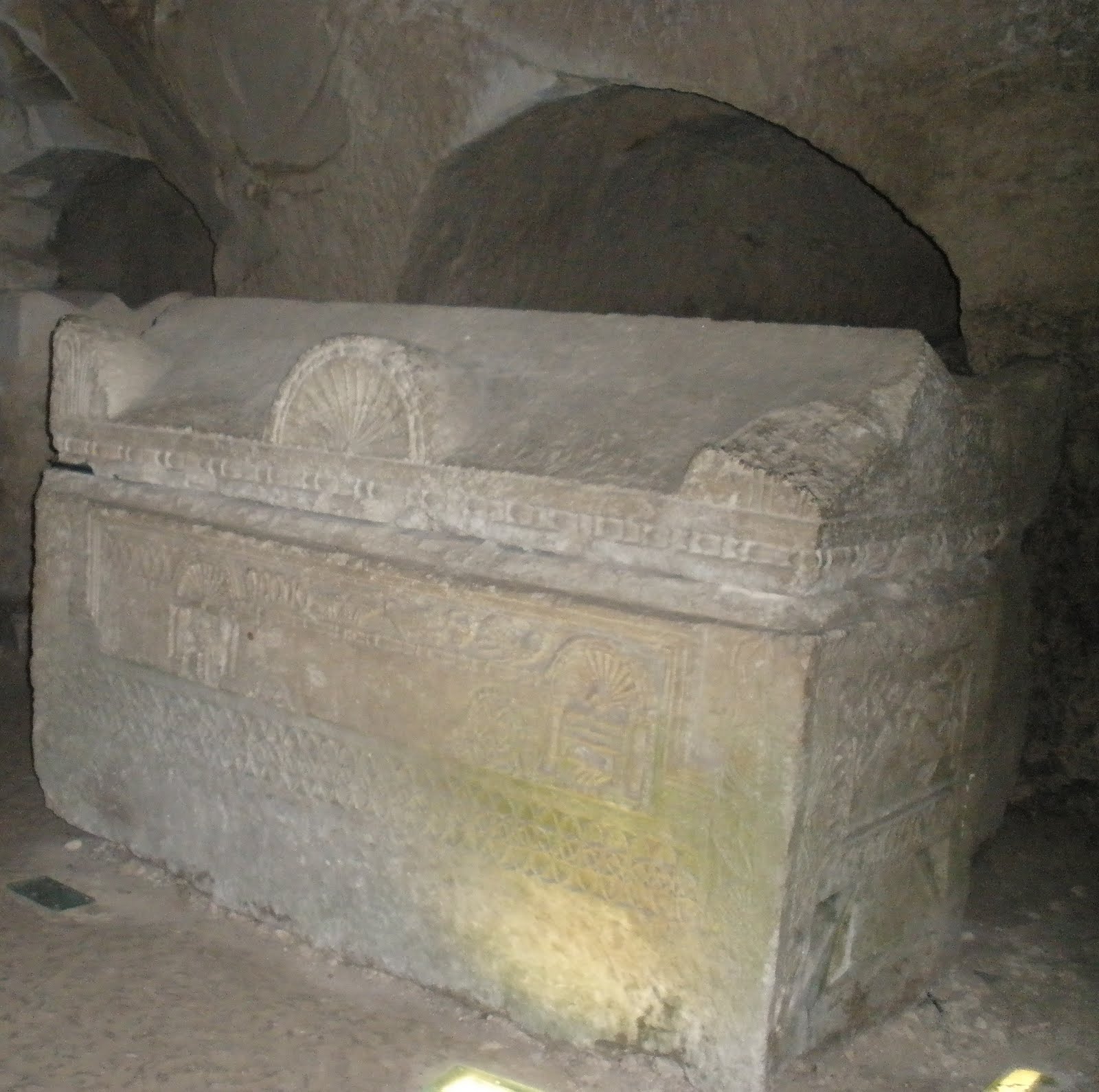
There are more than 30 catacombs with hundreds of stone coffins, not all are open to the public, but many are and there is a lot to see and to explore and it is all very interesting - and a bit chilly too.
The necropolis displays great splendor. Many of the sarcophagi are decorated with faces, flower motives, animal scenes and Jewish symbols, like the menorah, a rams horn (the shofar), a palm branch and the Ark of the Covenant.


Impressive facades in the style of classical architecture mark the entrances to the catacombs. Large stone doors on rotating axles lead to the underground caves.
Greek was the favored language at those times, the lingua franca, and often preferred to Hebrew and Aramaic. Many Jews had a Greek name in addition to their Hebrew one. Inscriptions in Hebrew, Aramaic and Greek can be found on the sarcophagi, according to the origin, profession and family connection of the buried.
The town of Beit Shearim flourished till 352 CE when it was destroyed by fire. In Byzantine time it was rebuilt and inhabited and after that it was settled by Arabs. From medieval time on the place was rather deserted and erased from the memory of the Jews, till its rediscovery in modern times.
Today the catacombs are a national park with a small museum as well,  and an admission fee has to be paid to visit. The necropolis was recently recognized by the UNESCO as world heritage.
Photographed by my husband Uri Eshkar, and by my niece, Alina Boldt on an earlier visit to Israel.